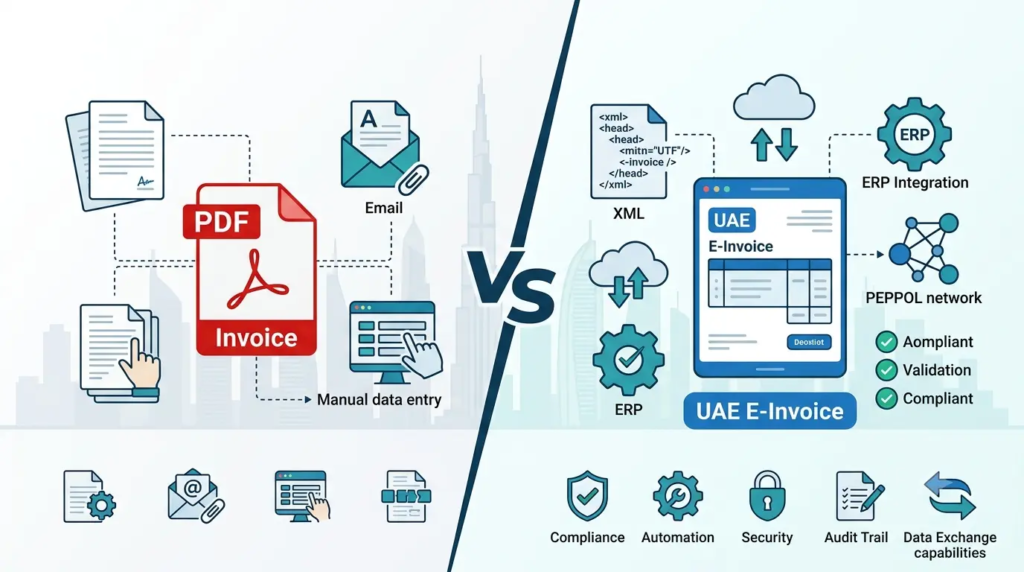
Businesses across the UAE have relied on PDF invoices for years. They are easy to create, send, and store. However, a PDF invoice is not the same as an e-invoice under the UAE’s upcoming e-invoicing framework. A PDF is a document that people can read, while a UAE e-invoice contains structured data that accounting systems can exchange and process automatically. The UAE Ministry of Finance defines an e-invoice as a structured electronic document exchanged between systems through the approved framework. PDFs, scanned invoices, Word files, and image files do not meet this definition because they are unstructured. Understanding this difference now will help your business prepare for future compliance, reduce manual work, and avoid costly changes later. According to the UAE Ministry of Finance, the national framework is built around structured electronic data exchange rather than document sharing.
What Is a UAE E-Invoice?
A UAE e-invoice is more than a digital version of a paper invoice. It is a structured electronic document that allows software systems to exchange invoice data automatically without manual entry.
Unlike a PDF, which is designed for people to read, an e-invoice is designed for both people and computer systems. Every piece of information follows a standard format, allowing accounting software, ERP systems, and approved service providers to process invoices accurately.
The UAE Ministry of Finance is introducing an e-invoicing framework that supports secure, standardized invoice exchange between businesses. The goal is to improve tax compliance, reduce processing errors, and support the country’s digital economy.
For businesses, this means invoicing will become faster, more accurate, and easier to manage as systems communicate directly with one another.
What Makes an Invoice an E-Invoice?
An invoice becomes an e-invoice when it contains structured data that software can read without human intervention.
A compliant e-invoice includes the same business information found on a traditional invoice, such as:
- Supplier details
- Customer details
- Invoice number
- Invoice date
- Tax Registration Number (TRN)
- VAT amount
- Product or service details
- Payment information
The difference lies in how this information is stored.
Instead of placing data inside a visual document, an e-invoice stores each field in a structured format. This allows accounting systems to identify, validate, and process every value automatically.
For example, a finance system can immediately recognize the invoice number, VAT amount, supplier information, and total value without anyone typing the data manually.
This improves accuracy and removes many repetitive accounting tasks.
How Structured Invoice Data Differs From PDF Documents
At first glance, a PDF invoice and an e-invoice may look similar because both contain the same business information.
The difference becomes clear when software tries to process them.
A PDF is primarily a visual document. It is created so people can read, print, or email it. Computers cannot reliably understand the contents without extra technologies such as optical character recognition or manual data extraction.
Structured invoice data works differently.
Each value is stored in predefined fields using a standardized format. Software immediately knows which number represents VAT, which field contains the invoice date, and which value identifies the supplier.
This structured approach offers several advantages:
- Less manual data entry
- Fewer processing errors
- Faster invoice validation
- Better data consistency
- Easier integration with accounting systems
- Improved audit readiness
For growing businesses, structured data also makes it easier to automate invoice processing as transaction volumes increase.
The Role of XML, PINT AE, and PEPPOL in the UAE Framework
The UAE e-invoicing framework relies on internationally recognized standards that allow different software systems to exchange invoice data consistently.
One of these standards is XML.
XML is a structured language used to organize invoice information into clearly defined fields. Rather than displaying information only for people, XML allows business systems to understand exactly what each piece of data represents.
The UAE framework also adopts PINT AE, which is the UAE implementation of the Peppol International Invoice standard. It defines how invoice information should be organized so businesses, accounting software, ERP systems, and accredited service providers exchange data using the same structure.
Another important part of the framework is PEPPOL.
PEPPOL is an international network that enables secure electronic document exchange between organizations. Instead of emailing invoices, participating systems exchange structured invoice data through approved access points using common technical standards.
For UAE businesses, these technologies work behind the scenes. Most companies will continue creating invoices through their existing accounting software or ERP system. A compliant e-invoicing solution helps convert invoice data into the required format before it is exchanged through the approved framework.
This approach allows businesses to modernize their invoicing process without changing how finance teams create invoices every day.
Why a PDF Invoice Is Not an E-Invoice Under the UAE Framework
Many businesses assume that sending an invoice as a PDF makes it an electronic invoice. This is one of the most common misconceptions surrounding the UAE e-invoicing programme.
The short answer is no. A PDF invoice is not an e-invoice under the UAE framework.
A PDF is simply a digital document. People can read it on a screen, download it, or print it. However, business systems cannot automatically interpret the information inside it as structured data.
A UAE e-invoice is different because it is created, validated, and exchanged in a structured electronic format that software systems understand without manual input.
The distinction affects every stage of invoice processing.
With a PDF invoice, finance teams often need to review information manually, enter data into accounting software, and correct mistakes before processing.
With a structured e-invoice, systems exchange validated data automatically. This reduces errors, speeds up processing, and creates a consistent audit trail.
Another important difference is how invoices move between businesses.
A PDF usually travels as an email attachment. While this remains convenient for sharing a copy with customers, it does not create the standardized electronic exchange required under the UAE framework.
An e-invoice moves securely between connected systems using approved technical standards. This supports accurate data validation, improves interoperability between different software platforms, and strengthens compliance reporting.
For businesses preparing for the UAE’s e-invoicing rollout, understanding this distinction is the first step. Once you know why a PDF is not considered an e-invoice, it becomes much easier to evaluate your current invoicing process and identify the changes needed for future compliance.
In the next section, we’ll compare PDF invoices and UAE e-invoices side by side to highlight the practical differences that affect your daily operations and long-term compliance.
E-Invoice vs PDF Invoice: Side-by-Side Comparison
At first glance, a PDF invoice and a UAE e-invoice may appear similar. Both contain details such as the supplier’s name, customer information, invoice number, VAT amount, and payment terms.
The real difference lies in how the information is created, exchanged, and processed.
A PDF is mainly designed for people to read. A UAE e-invoice is designed for both people and business systems. Structured invoice data allows accounting software, ERP platforms, and approved service providers to process invoices automatically while reducing manual work.
The table below highlights the key differences that matter for UAE businesses preparing for the national e-invoicing framework.
| Feature | PDF Invoice | UAE E-Invoice |
| File format | PDF document | Structured electronic format such as XML |
| Data structure | Unstructured | Structured data |
| Machine readability | Limited | Fully machine readable |
| Human readability | Yes | Yes, when rendered by software |
| Data entry | Often manual | Automated |
| Invoice validation | Manual review | Automatic validation |
| Error detection | Usually after processing | Detected before or during exchange |
| Invoice exchange | Email or file sharing | Secure system to system exchange |
| Processing speed | Slower | Faster |
| ERP integration | Limited | Native integration with ERP and accounting software |
| PEPPOL compatibility | No | Yes |
| PINT AE compliance | No | Yes |
| Regulatory reporting | Manual preparation | Supports standardized reporting |
| Audit trail | Basic document history | Digital transaction history |
| Data integrity | Can change without detection | Structured validation helps protect data integrity |
| Security | Depends on document handling | Secure electronic exchange through approved framework |
| Digital signatures | Optional | Can support secure authentication where applicable |
| Scalability | Less suitable for high invoice volumes | Designed for large scale automation |
| Compliance readiness | Does not meet the UAE e-invoicing definition | Designed for the UAE framework |
| Long term business value | Limited automation | Supports digital transformation and future compliance |
This comparison shows that the biggest difference is not the appearance of the invoice. It is the structured data behind it. That data allows business systems to exchange information accurately without relying on manual work.
The Core Differences That Affect Your Business
Understanding the comparison is only the first step. The next question is more practical.
How will these differences affect your daily operations?
Whether you manage a small business or a large enterprise, the way invoices move through your finance process affects efficiency, compliance, and customer experience.
Data Structure and Processing
Every invoice contains important business information.
This includes:
- Supplier details
- Customer details
- Invoice number
- Invoice date
- TRN
- VAT amount
- Products or services
- Total payable amount
A PDF stores this information as visual content.
People can read it easily. Software cannot reliably identify every field without additional processing.
A UAE e-invoice stores each value in a structured format. Every field has a defined purpose. Accounting software immediately understands what each value represents.
For example, the system can identify the VAT amount without anyone entering it manually.
This removes repetitive work and reduces processing time.
Businesses that process hundreds or thousands of invoices each month benefit the most from structured invoice data.
Validation and Data Accuracy
Manual invoice processing increases the chance of mistakes.
Common problems include:
- Incorrect invoice numbers
- Missing VAT details
- Wrong customer information
- Duplicate invoices
- Data entry errors
These issues often require extra checks before payment or reporting.
Structured e-invoices improve accuracy because software validates invoice data before or during exchange.
If required information is missing, the issue can be identified earlier in the process.
Earlier validation means finance teams spend less time correcting errors.
It also helps businesses maintain consistent financial records.
Regulatory Reporting and Compliance
The UAE is building a standardized electronic invoicing framework to improve tax compliance and digital reporting.
Businesses that continue relying only on PDF invoices may need additional manual work to meet future requirements.
Structured invoice data supports consistent reporting because every invoice follows the same format.
This makes financial information easier to process, review, and reconcile.
As the UAE e-invoicing programme progresses, businesses with structured invoice workflows will be better prepared for new compliance requirements.
Preparing early also reduces pressure when implementation phases begin.
Audit Trail and Document Integrity
During an audit, businesses need complete and accurate records.
PDF invoices usually show the final document.
They do not always provide a detailed history of how invoice data moved between systems.
Structured e-invoices create a stronger digital record throughout the exchange process.
Each transaction follows a standardized workflow.
This improves transparency and makes it easier to review invoice activity when needed.
Better record keeping also supports internal controls and financial governance.
Automation and Operational Efficiency
Many finance teams still spend hours every week entering invoice data manually.
This work slows payment cycles and increases administrative costs.
Structured e-invoices automate many routine tasks.
Invoice information moves directly between connected systems.
Finance teams spend less time entering data and more time reviewing exceptions or supporting business decisions.
Automation also offers several practical benefits:
- Faster invoice processing
- Lower administrative workload
- Better productivity
- Quicker approvals
- Improved cash flow visibility
- Easier invoice tracking
These improvements become more valuable as a business grows.
Fraud Prevention and Invoice Authenticity
Invoice fraud remains a concern for many businesses.
Email attachments can be altered, duplicated, or replaced before they reach the recipient.
Manual processing also makes unusual transactions harder to identify.
The UAE e-invoicing framework introduces standardized electronic exchange that helps improve invoice authenticity and data consistency.
Structured validation makes it easier to detect missing or inconsistent information before invoices enter financial systems.
While no system can eliminate every risk, standardized electronic processing provides stronger controls than relying only on document-based workflows.
For businesses, this means greater confidence in the invoices they send, receive, and process every day.
Now that you understand the operational differences between PDF invoices and structured e-invoices, the next question becomes even more important.
Can You Continue Using PDF Invoices in the UAE?
This is one of the most common questions businesses ask as the UAE prepares to introduce its e-invoicing framework.
The short answer is yes, for now. However, businesses should understand that a PDF invoice alone is not considered a compliant e-invoice under the UAE framework. The UAE Ministry of Finance defines an e-invoice as a structured electronic document exchanged between systems using the approved framework. A PDF remains an unstructured document, even if it contains all the required invoice details.
The right approach depends on your current stage of preparation and the implementation phase of the UAE e-invoicing programme.
Before Mandatory Implementation
Many businesses currently issue invoices as PDF files through accounting software, ERP systems, or custom billing applications.
This process can continue until the relevant e-invoicing requirements apply to your business.
That said, this is the right time to review your invoicing process.
Ask yourself:
- Does your software support structured invoice data?
- Can it integrate with the UAE e-invoicing framework?
- Will it work with an Accredited Service Provider (ASP)?
- Can your finance team adapt without disrupting daily operations?
Planning early reduces pressure later.
After Implementation
Once your business falls within the mandatory scope of the UAE framework, invoices exchanged for compliance purposes will need to follow the required structured format.
Simply creating or emailing a PDF will not satisfy the electronic exchange requirements.
Businesses should ensure their invoicing solution can generate structured invoice data and exchange it through the approved framework.
Preparing before your implementation phase begins helps avoid unnecessary changes during business operations.
Can You Still Keep PDF Copies?
Yes.
Many businesses will continue using PDF invoices as customer-friendly copies or for internal reference.
A PDF is easy to read and remains useful for:
- Sharing invoices with customers
- Internal approvals
- Record keeping
- Printing when required
The key point is that the PDF becomes a representation of the invoice, not the compliant electronic invoice itself.
The structured invoice data remains the official electronic record used for system-to-system exchange.
Hybrid Workflows Will Be Common
Businesses do not need to choose between PDFs and structured invoices.
Many organizations will use both.
For example:
- Your ERP creates the invoice.
- The structured invoice is exchanged through the approved framework.
- A PDF version is automatically generated for the customer.
This approach allows businesses to maintain familiar customer communication while meeting future compliance requirements.
What This Means for Your Current ERP and Invoicing Workflow
Many business owners worry that the UAE e-invoicing programme will require replacing their existing accounting software or ERP system.
In many cases, that is not necessary.
The goal is to make your current workflow compliant rather than rebuild it from the beginning.
Businesses Using Excel or Word
Some small businesses still prepare invoices manually.
While this may work today, manual invoicing creates challenges as businesses grow.
It increases the risk of:
- Data entry errors
- Missing information
- Duplicate invoices
- Slow processing
Businesses using spreadsheets should begin evaluating accounting software that supports structured invoice data and future integration.
Businesses Using Accounting Software
If you already use accounting software, you may be in a stronger position.
Many software providers are preparing products to support electronic invoicing standards.
Before making changes, ask your software provider:
- Will the software support the UAE framework?
- Can it generate structured invoice data?
- Will updates be available before implementation?
- Does it integrate with an Accredited Service Provider?
Understanding these answers now helps you plan with confidence.
Businesses Using ERP Systems
Organizations using ERP platforms such as SAP, Oracle, Microsoft Dynamics, or Odoo often have more flexibility.
Many modern ERP systems already support electronic invoicing in different countries.
Your implementation team should review:
- Current invoice workflows
- System compatibility
- Required integrations
- Data mapping
- Testing requirements
A structured review helps avoid unexpected issues during implementation.
How Invoiceify Integrates With Existing Workflows
Invoiceify is designed to work alongside your existing accounting software or ERP system.
Instead of replacing your finance process, it helps businesses prepare invoice data for the UAE framework and supports secure electronic exchange through approved standards.
This allows finance teams to continue using familiar systems while preparing for future compliance.
UAE E-Invoicing Timeline: What Businesses Should Prepare For
The UAE Ministry of Finance has announced a phased approach to implementing e-invoicing across the country.
This allows businesses, software providers, and service providers to prepare before requirements become mandatory.
Rather than focusing on specific dates, businesses should focus on readiness.
Key preparation steps include:
- Review your current invoicing process.
- Identify how invoices move through your business.
- Confirm whether your software supports structured invoice data.
- Speak with your ERP or accounting software provider.
- Understand how an Accredited Service Provider fits into your workflow.
- Train finance teams on future processes.
- Monitor official announcements from the Ministry of Finance.
Early preparation reduces business disruption and gives teams enough time to test new processes before they become mandatory.
Common Misconceptions That Create Compliance Risks
Many businesses have heard about e-invoicing but still misunderstand how the UAE framework works.
These misconceptions can delay preparation and create unnecessary compliance risks.
| Myth | Fact |
| A PDF invoice is an e-invoice. | A PDF is an unstructured document. It does not meet the UAE definition of a structured electronic invoice. |
| Emailing a PDF is enough. | Email is only a delivery method. The framework requires structured electronic exchange between systems. |
| Only large companies need to prepare. | The UAE is introducing e-invoicing in phases. Businesses should monitor official guidance to understand when requirements apply to them. |
| My ERP is automatically compliant. | An ERP may require updates or integration before it supports the UAE framework. |
| I need to replace all my accounting software. | Many businesses can adapt their existing systems instead of replacing them completely. |
| Structured invoices and tax invoices are different things. | A structured e-invoice can also be a tax invoice if it contains the required tax information. |
| I can wait until the last minute. | Early planning gives businesses time to review systems, train staff, and complete testing before implementation. |
Understanding these facts helps businesses make informed decisions instead of reacting when new requirements take effect.
How to Move From PDF Invoicing to UAE Compliant E-Invoicing
Moving from PDF invoices to UAE compliant e-invoicing does not have to be complicated. Most businesses can build on their existing invoicing process instead of starting from scratch.
A structured plan helps reduce disruption and gives your finance team time to adapt before the UAE e-invoicing framework applies to your business.
Review Your Current Invoicing Process
Start by understanding how invoices move through your business.
Ask questions such as:
- How are invoices created?
- Who approves them?
- How are they sent to customers?
- How is invoice data stored?
- Which steps still depend on manual work?
Mapping your current workflow makes it easier to identify where changes may be needed.
Assess Your ERP or Accounting Software
Your next step is to evaluate your existing software.
Many accounting platforms and ERP systems are preparing support for the UAE e-invoicing framework.
Speak with your software provider and ask whether the system can:
- Generate structured invoice data
- Support the required invoice standards
- Connect with an Accredited Service Provider
- Receive future compliance updates
If your current software can be updated, you may not need to replace it.
Choose a Compliant E-Invoicing Solution
Selecting the right solution is an important business decision.
Look for a platform that can:
- Support the UAE e-invoicing framework
- Integrate with your existing ERP or accounting software
- Exchange invoices securely
- Validate invoice data before submission
- Scale as your business grows
A solution should fit into your current workflow instead of forcing your team to learn an entirely new process.
Test Your Integrations
Before moving to production, test every stage of your invoicing process.
Testing helps confirm that:
- Invoice data is accurate.
- Customer information transfers correctly.
- VAT details remain consistent.
- Systems exchange invoices successfully.
- Finance teams understand the updated workflow.
Finding issues during testing is much easier than correcting them after implementation.
Train Your Finance Team
Technology alone does not guarantee compliance.
Your finance team should understand:
- The difference between PDF invoices and structured e-invoices
- Updated approval processes
- New validation checks
- Exception handling
- Record management
Well-trained employees help ensure a smooth transition.
Monitor Compliance After Implementation
E-invoicing is not a one-time project.
Businesses should continue reviewing their invoicing process as regulations, software, and business requirements evolve.
Regular reviews help identify:
- Processing issues
- Validation errors
- System updates
- Workflow improvements
Continuous monitoring keeps your invoicing process efficient and ready for future changes.
Why Businesses Are Moving to E-Invoicing Before It Becomes Mandatory
Many UAE businesses are preparing now instead of waiting for mandatory implementation.
Early preparation gives finance teams time to review systems, improve workflows, and avoid last-minute changes.
One of the biggest advantages is faster invoice processing.
Structured invoice data moves directly between connected systems. This reduces manual work and shortens processing times.
Businesses also experience fewer manual errors.
When invoice information transfers automatically, finance teams spend less time correcting mistakes caused by manual data entry.
Another benefit is better cash flow.
Invoices that move through the approval process more quickly can help reduce payment delays and improve financial visibility.
E-invoicing also supports simpler audits.
Structured invoice records make it easier to locate information and demonstrate consistent record keeping.
As businesses grow, automation becomes even more valuable.
Processing hundreds or thousands of invoices manually requires significant time and resources.
A structured invoicing process supports business growth without increasing administrative work at the same pace.
Preparing early also gives businesses time to test software, train employees, and refine internal processes before compliance requirements apply.
Why Choose Invoiceify for UAE E-Invoicing?
Preparing for UAE e-invoicing should not require replacing the systems your business already relies on.
Invoiceify is designed to help businesses adopt compliant e-invoicing while working with existing accounting software and ERP platforms.
Built for UAE Compliance
Invoiceify is designed around the UAE e-invoicing framework and supports structured invoice exchange that aligns with official requirements.
Easy ERP Integration
Whether you use accounting software or an enterprise ERP system, Invoiceify helps connect your existing workflow without unnecessary disruption.
Secure Invoice Exchange
Invoiceify supports secure electronic invoice exchange while helping businesses maintain accurate and consistent invoice data.
Scalable for Growing Businesses
From small businesses to large organizations, Invoiceify supports increasing invoice volumes without adding unnecessary manual work.
Dedicated Implementation Support
Every business has different systems and processes.
Invoiceify helps businesses plan implementation, integrate existing software, and prepare finance teams for a smooth transition.
Frequently Asked Questions
Is a PDF invoice valid under the UAE e-invoicing framework?
A PDF may remain useful as a customer copy or internal document. However, a PDF alone is not considered a compliant e-invoice because it does not contain structured invoice data.
Will the FTA accept PDF invoices after the e-invoicing mandate begins?
Businesses should follow the latest guidance issued by the UAE Ministry of Finance and the Federal Tax Authority. The UAE framework is based on structured electronic invoice exchange rather than PDF documents.
Can my ERP generate compliant e-invoices?
Many modern ERP systems can support e-invoicing. The exact capabilities depend on your software provider, system configuration, and future updates for the UAE framework.
Do small businesses need to comply?
The UAE is introducing e-invoicing in phases. Businesses should monitor official announcements to understand when the requirements apply to them.
Can I still send customers a PDF copy?
Yes. Many businesses will continue providing PDF copies for customer convenience while exchanging the official invoice in a structured electronic format.
What is structured invoice data?
Structured invoice data stores every invoice field in a standardized format that software systems can understand and process automatically.
What is PEPPOL, and why is it used?
PEPPOL is an international network that enables secure electronic document exchange between businesses. The UAE framework uses PEPPOL standards to support consistent and interoperable invoice exchange.
Can I convert existing PDF invoices into compliant e-invoices?
Creating a compliant e-invoice involves generating structured invoice data. Simply converting a PDF into another file format does not create a compliant electronic invoice.
What happens if my customer is not ready for e-invoicing?
The UAE is implementing the framework in phases. Businesses should follow official guidance and work with their software providers to understand how invoices should be exchanged during each implementation stage.
Will e-invoicing replace tax invoices?
No. An e-invoice describes how invoice data is created and exchanged. A tax invoice describes what information must be included for tax purposes. Under the UAE framework, a structured e-invoice can also serve as a tax invoice when it contains the required tax information.
Are there penalties for non-compliance?
The UAE Ministry of Finance and the Federal Tax Authority will provide guidance on compliance obligations and any applicable enforcement measures. Businesses should monitor official announcements and prepare early to avoid unnecessary compliance risks.
Final Thoughts
The move from PDF invoices to structured e-invoicing is more than a technical change. It is a step toward faster, more accurate, and more connected business processes.
Businesses that begin preparing now will have more time to review their systems, train their teams, and adopt compliant workflows with confidence. By understanding the differences between PDF invoices and UAE e-invoices today, you can make informed decisions that support future compliance and improve the efficiency of your invoicing process.