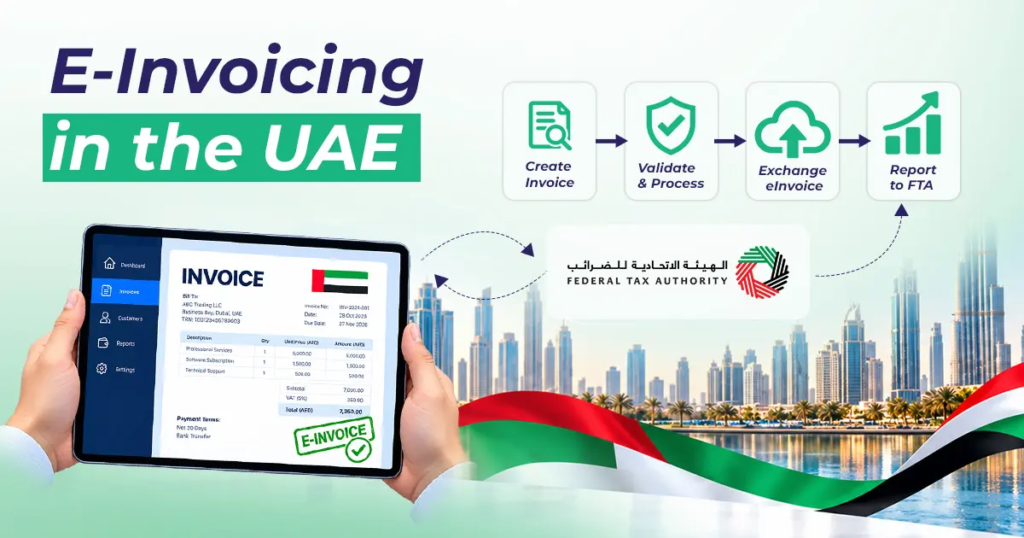
Quick answer: UAE e-invoicing is mandatory in phases from 1 January 2027. Businesses must issue, receive, and report invoices as structured digital data (Peppol PINT AE format) through an Accredited Service Provider (ASP). Businesses with annual revenue of AED 50 million or more must appoint an ASP by 30 October 2026 and go live on 1 January 2027. All other in-scope businesses must appoint an ASP by 31 March 2027 and go live on 1 July 2027. A PDF sent by email does not count as an eInvoice.
UAE e-invoicing deadlines at a glance
| Phase | Who | Appoint an ASP by | Go live by |
| Pilot | Businesses invited by the Ministry (voluntary participation also open) | Not applicable | From 1 July 2026 |
| Phase 1 | Annual revenue of AED 50 million or more | 30 October 2026 | 1 January 2027 |
| Phase 2 | Annual revenue below AED 50 million | 31 March 2027 | 1 July 2027 |
| Government entities | In-scope government entities | 31 March 2027 | 1 October 2027 |
The Phase 1 appointment deadline was originally 31 July 2026. Ministerial Decision No. 66 of 2026 moved it to 30 October 2026. The go-live dates did not change. The framework itself comes from Ministerial Decisions 243 and 244 of 2025.
Phase 1 business without an ASP? The appointment deadline is 30 October 2026. Contact accredited providers now, ask about onboarding capacity, and sign an appointment agreement as soon as you can. Industry sources report a penalty of AED 5,000 per month for missing the appointment deadline. Check the MoF portal for any further updates.
Which phase is your business in?
Your phase depends on your annual revenue for the most recent accounting period. Work through these three checks:
- Check your revenue. AED 50 million or more puts you in Phase 1. Below that, you are in Phase 2.
- Check your transactions. The system applies to the business transactions of any business operating in the UAE, whether or not it is VAT-registered. Its focus is business-to-business (B2B) and business-to-government (B2G) transactions. Confirm current exclusions, including how consumer (B2C) sales are treated, on the MoF portal.
- Check your entity type. Government entities follow their own timeline (appoint by 31 March 2027, go live by 1 October 2027).
Do not assume every business or every transaction follows the same timeline.
How is an eInvoice different from a PDF?
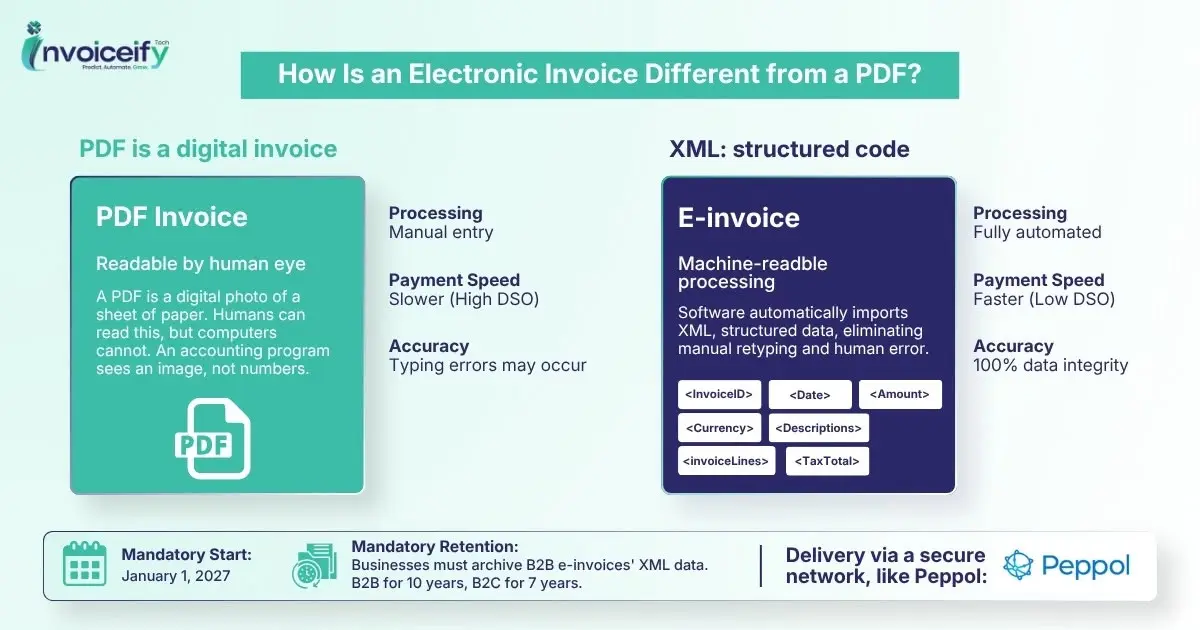
An eInvoice is structured data (a machine-readable file in the PINT AE format) that software can validate and exchange automatically. A PDF is an image of an invoice. It looks right to a person but has no fields a system can read reliably, so a PDF emailed to a customer does not meet the UAE definition. A scanned invoice does not either.
In practice, this means:
- A tool that only produces PDFs cannot meet the requirement.
- The invoice data in your ERP or accounting system matters more than the invoice layout.
- Your invoice is checked against rules before it reaches the buyer, so errors are caught (and rejected) early.
How UAE e-invoicing works: the 5-corner model
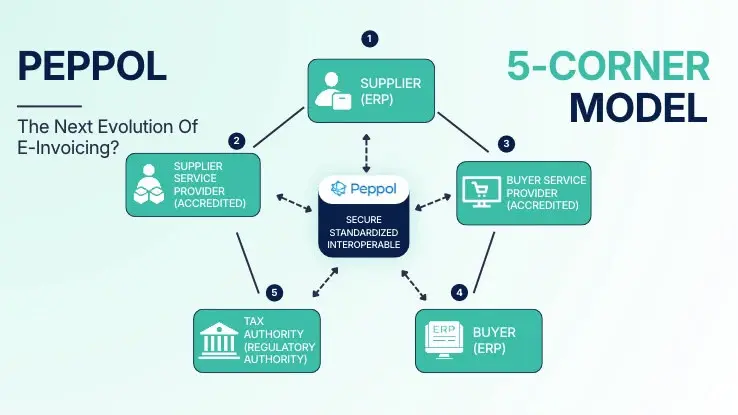
The UAE uses a Peppol-based five-corner model, which the Ministry of Finance calls the Decentralized Continuous Transaction Control and Exchange (DCTCE) model. Your business never sends invoices directly to the buyer or to the FTA. Your ASP does it for you.
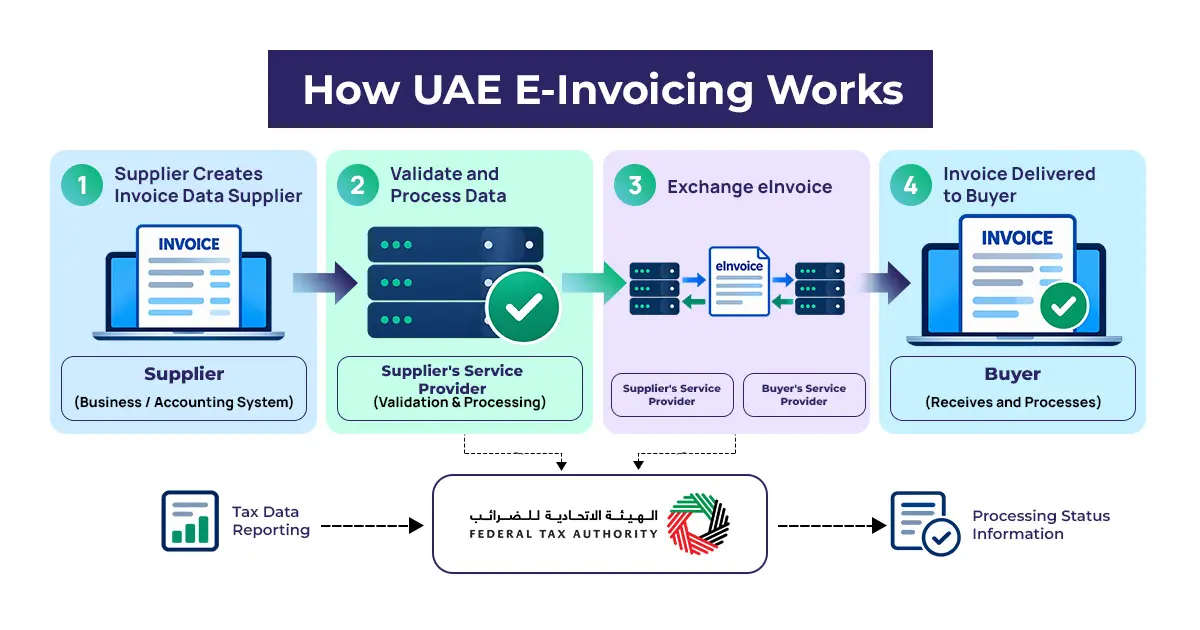
- Corner 1: the supplier. You create the invoice in your ERP or accounting system and send the data to your ASP.
- Corner 2: the supplier’s ASP. Your provider validates the data, converts it to PINT AE if needed, and sends back any errors for correction.
- Corner 3: the buyer’s ASP. Your provider sends the eInvoice across the Peppol network to the buyer’s provider.
- Corner 4: the buyer. The buyer’s provider delivers the invoice to the buyer’s system. Status messages travel back along the same route.
- Corner 5: the Federal Tax Authority. The required tax data is reported to the FTA as part of the exchange.
Because every business needs its own ASP, a single invoice normally involves two different providers. That is why the provider you choose must be accredited and reliably connected to the network.
What invoice data do you need?
The MoF published the final mandatory field list in early 2026, aligned with Peppol PINT AE. The key points for your data team:
- Participant identifier: your Tax Identification Number (TIN), which is the first 10 digits of your corporate tax registration number (TRN).
- Line-level detail: line ID, quantity, unit of measure, item price, tax category, and tax rate for every line.
- AED equivalents: amounts in foreign currency need AED equivalents.
- Customer details: accurate buyer identifiers, because the invoice is routed using them.
Common gaps to check before a project starts:
- Customers with missing or inconsistent TRN/TIN values in the customer master.
- Free-text units of measure and tax categories that do not map to standard codes.
- Foreign-currency invoices with no stored AED equivalent.
- Manual invoices created outside the ERP, in spreadsheets or documents.
Fixing these before you connect to an ASP is the cheapest part of the project.
What happens if you miss a deadline?
Industry sources report penalties of AED 5,000 per month for failing to appoint an ASP on time, and AED 100 per invoice not issued or transmitted through the system, capped at AED 5,000 per month. These figures come from secondary sources, so confirm the current amounts against the official Cabinet and ministerial decisions before relying on them for budgeting.
How to choose an Accredited Service Provider
Start with the MoF accredited list, not any older pre-approved list. Then ask each shortlisted provider these questions:
- Accreditation: Is the provider on the current MoF accredited list? Can they show it?
- Your ERP: Do they have a tested connector for your exact system and version? If not, who builds the integration and who pays for it?
- Onboarding capacity: How long does onboarding take, and can they commit to your go-live date? Capacity may tighten close to each deadline.
- Error handling: How are rejected invoices shown, who can see them, and how quickly can your team fix and resend them?
- Document types: Do they support credit notes, debit notes, multi-currency, multiple entities, and recurring invoices?
- Testing: Is there a sandbox so you can test before go-live?
- Records: How are invoices stored, for how long, and can you export them?
- Pricing: Is pricing per invoice, per subscription, or tiered by volume? Are integration and onboarding fees extra?
- Support: What support hours, languages, and response times are included?
A good provider answers these with specifics. If answers stay vague, treat that as a signal.
How to choose an Accredited Service Provider
Start with the MoF accredited list, not any older pre-approved list. Then ask each shortlisted provider these questions:
- Accreditation: Is the provider on the current MoF accredited list? Can they show it?
- Your ERP: Do they have a tested connector for your exact system and version? If not, who builds the integration and who pays for it?
- Onboarding capacity: How long does onboarding take, and can they commit to your go-live date? Capacity may tighten close to each deadline.
- Error handling: How are rejected invoices shown, who can see them, and how quickly can your team fix and resend them?
- Document types: Do they support credit notes, debit notes, multi-currency, multiple entities and recurring invoices?
- Testing: Is there a sandbox so you can test before go-live?
- Records: How are invoices stored, for how long, and can you export them?
- Pricing: Is pricing per invoice, per subscription or tiered by volume? Are integration and onboarding fees extra?
- Support: What support hours, languages and response times are included?
A good provider answers these with specifics. If answers stay vague, treat that as a signal.
How to connect e-invoicing to your ERP or accounting software
Most businesses keep their existing system and connect it to an ASP. There are three usual approaches:
- Native connector: the ASP already supports your software. This is usually the fastest option.
- API integration: your ERP sends invoice data to the ASP’s API. This suits custom systems and larger enterprises, and needs developer time.
- File-based or middleware integration: invoices are exported from your system and uploaded or routed through an intermediate tool. This can bridge older systems but needs more manual control.
Whichever route you take, work through the same steps:
- Map your data. Match each ERP field to the required invoice fields and fix the gaps listed above.
- Confirm responsibilities. Agree in writing who handles the ERP changes, who handles the ASP side, and who owns error resolution.
- Test with real scenarios. Run standard invoices, credit notes, foreign-currency invoices and deliberately incomplete invoices. Check how rejections appear.
- Run in parallel. Where possible, test with a few customers before the full cutover.
- Document the process. Make sure finance staff know what to do when an invoice is rejected.
Your preparation timeline
Phase 1 businesses (AED 50 million or more)
- By 30 October 2026: appoint an ASP.
- November 2026: map data, agree the integration approach and begin development.
- December 2026: test end-to-end and train finance staff.
- 1 January 2027: go live.
Phase 2 businesses (below AED 50 million)
- Now to end of 2026: confirm scope, clean customer and invoice data, and shortlist providers.
- Q1 2027: appoint an ASP (deadline 31 March 2027). Appointing earlier gives you more onboarding time.
- April to June 2027: build, connect and test.
- 1 July 2027: go live.
Do not wait for your own deadline to approach. Onboarding capacity and integration time are the usual bottlenecks.
What e-invoicing means for different types of business
SMEs moving from manual invoicing. If you issue invoices from spreadsheets or Word templates, you will need invoicing software that produces structured data. This is the biggest change but usually the simplest to solve, because there is no legacy ERP to integrate.
Growing businesses. As volumes rise, rejected invoices become a daily workload. Prioritise clear error reporting, bulk handling, and automation of recurring invoices.
Enterprises with multiple systems. The challenge is coordination: several ERPs, entities and tax registrations. Agree on one integration architecture, one owner for data standards, and a clear test plan per system.
Trading and distribution. High volumes, frequent credit notes, and many customers make customer master data quality critical. Check that credit notes and multiple locations are supported.
Manufacturers. Invoices often depend on data from procurement, inventory and sales systems. Map where each invoice field originates before choosing an integration approach.
Service businesses. Recurring invoices, project billing and customer-specific details are the main concerns. Confirm that your accounting software can export every required field per invoice line.
How Invoiceify can help
Invoiceify Technologies is a UAE-based technology company specialising in e-invoicing services. We are pre-approved by the UAE Ministry of Finance, Peppol-certified, and an implementation partner of an Accredited Service Provider (ASP). That means we take care of the practical side of becoming compliant, from connecting your systems to getting your invoices flowing through the UAE e-invoicing network and reported to the Federal Tax Authority.
Frequently Asked Questions
It is a mandatory system where businesses issue, receive and report invoices as structured digital data through Accredited Service Providers on a Peppol-based five-corner model, with tax data reported to the FTA.
It is being introduced in phases for in-scope transactions, mainly B2B and B2G. Your obligation depends on your revenue, entity type, and transactions. Confirm exclusions on the MoF portal.
Revenue of AED 50 million or more: appoint an ASP by 30 October 2026 and go live by 1 January 2027. Below AED 50 million: appoint by 31 March 2027 and go live by 1 July 2027. Government entities: appoint by 31 March 2027 and go live by 1 October 2027.
No. A PDF sent by email does not meet the UAE definition. An eInvoice must be structured data in the required format, exchanged through the ASP network.
An ASP is a provider accredited by the Ministry of Finance to validate, exchange and report eInvoices on your behalf. Verify any provider on the official accredited list before signing.
Usually not. Most businesses connect their existing ERP or accounting software to an ASP through a connector, API or file-based integration. Ask your provider to confirm support for your exact system and version.
The participant identifier is your TIN, defined as the first 10 digits of your corporate tax registration number (TRN).
Industry sources report penalties of AED 5,000 per month for not appointing an ASP on time and AED 100 per invoice not issued or transmitted, capped at AED 5,000 per month. Check the current official decisions for exact terms.
Share your invoicing process, software, invoice volumes and deadline with the Invoiceify team and ask for a demonstration against those requirements.